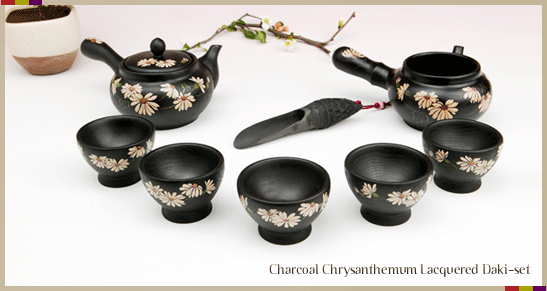
| Charcoal
Chrysanthemum Lacquered Tea-set |
 |
|
|
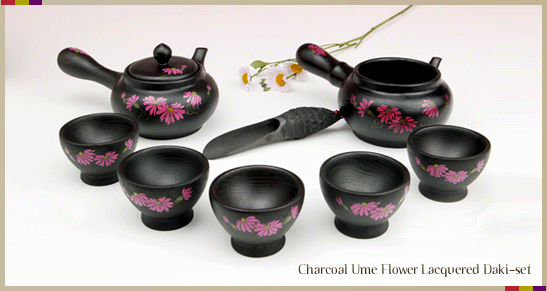
| Charcoal
Ume Flower Lacquered Tea-set |
 |
|
|
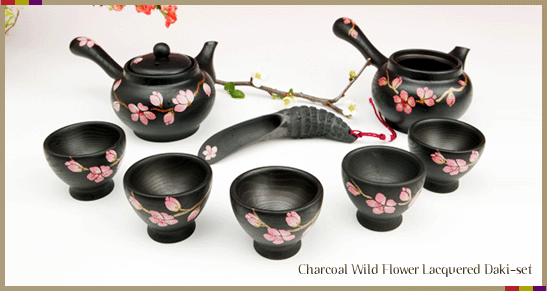
| Charcoal
Wild Flower Lacquered Tea-set |
 |
|
|
| Charcoal
Chinaware |
Charcoal
Chinaware is an artwork that employs various techniques
in terms of wood processing,
drying, kilning, lacquering as well as flower painting
which requires a high level of technical
proficiency.
Most of the manufacturing process is carried out
by hand to guarantee the highest quality
possible and all flowers are drawn manually with
clinically-tested colored lacquer. In addition,
the lacquer used for finishing is thinly coated
numerous times to enhance durability and trans-
parency. It is highly recommended for your collection
as it contains highly acclaimed artisanship
and devotion. |
| Product Description: Charcoal Chinaware Tea Set, Wine Cup Set, Tea Cup Set, Mug Set |
|
- Charcoal Chinaware is a wooden container
in naturally formed porosity.
- It has strong durability and is lightweight. (Clear
sound is heard when tapping)
- There is no cracking or smearing of any kind.
- It improves and softens the taste of tea or wine.
- It has a variety of benefits including anti-bacterial
and deodorization effects and mildew resistance.
- It engenders a feeling of warmth and intimacy
and delivers a natural sense of wood.
- Clinically-tested colored lacquer is coated on
a wooden surface numerous times to maximize its
commercial value and distinctiveness. |
It has a high effect of radiation
prevention as well as 99.0% and 99.5% of colon and
pyogenic bacteria reduction respectively. Also,
it shows high resistance toward mildew.
Because it has been tested for lead and cadmium
resulting in “zero” per cent and fully approved
by other various tests, it can be safely used as
a container for food and beverages.
|
| Characteristics of Wooden Material |
|
Ash tree has a strong durability and
solidity, and when used in craftwork it displays
beautiful patterns. It is widely used for various
kinds of artwork, musical and sports instruments.
In addition, its bark has a medicinal use.
|
| |
In general, in order to use wood for
craftwork, it requires a drying period of at least
six months. However, Charcoal Chinaware has developed
a method of preserving proper moisture level and
has significantly reduced the processing period
for both large and processed wooden material.
|
|
The manufacturing of Charcoal Chinaware
differs considerably from those of general charcoal
processing. It is kilned with exclusively-developed
methods and a specially devised kiln where it is
reduced by 50% from its original size causing the
final product to have strong durability without
cracking.
|
| |
There are various kinds of charcoal
from ordinary charcoals produced at a relatively
low temperatures to those of fine quality produced
with extremely high heat (1000℃). However, those
with a high carbon rate and low electrical resistance
are considered the finest. It is extremely difficult
to mass produce high-quality charcoal. Charcoal
Chinaware is considered one of the highest quality
charcoals. It requires two to three weeks of kilning
process at a temperature of more 1000℃. Once kilned,
its size reduces by up to 50% and it has electrical
resistance of less than 10(Ω).
|
| Lacquering / Flower Painting |
|
Lacquering on Charcoal Chinaware requires
highly proficient skill. By applying several layers
of thin lacquer film, the active effect of a charcoal
is properly controlled and its life can be extended.
Flower painting needs repeating five to six times
over about two weeks because the surface absorbs
the colored lacquer. It takes high proficiency to
complete the entire process.
|
|
|
After being kilned, the charcoal dusts
remaining on the surface are removed three times
and several layers of thin lacquer film are applied
followed by flower painting to improve its quality
as luxury chinaware.
|
|
|
- Do not wash with detergent. If it
has been washed with detergent, boil in hot water
for 1 minute.
- Clean with a wet towel and sponge.
- Do not subject to strong impact or throw it.
- Do not scratch with sharp objects such as knife
and needle, as it might damage the product.
|
|
| Far Infrared
Ray Test |
| Far Infrared
Ray Test |
| Far Infrared Ray
Emitted Amount(40℃) |
Test Result |
| Emissivity (5~20μm) |
0.927 |
| Radiant Energy (W/m2) |
3.74x10² |
|
| Colon
and Pyogenic Bacteria Test |
| Colon
and Pyogenic Bacteria Test |
| Test
Item |
Test Result |
| Initial Concentration(CFU/40p) |
Concentration after 24 hrs(CFU/40p) |
Reduction rate(%) |
| Colon
Bacteria Test |
BLANK |
|
|
|
| Charcoal Chinaware |
|
|
|
| Pyogenic Bacteria
Test |
BLANK |
|
|
|
| Charcoal Chinaware |
|
|
|
|
| Anti-Mildew
Test |
| Anti-Mildew
Test |
| Test
Item |
Cultivation Period |
| After 1 week |
After 2 weeks |
After 3 weeks |
After 4 weeks |
|
| Test Result |
|
|
|
|
|
|
| Lead, Cadmium
Test |
| Lead, Cadmium
Test |
| Test Item |
Criteria |
Test Result |
| Lead (mg/kg) |
Less than 5.0 |
|
| Cadmium (mg/kg) |
Less than 0.5 |
|
|
| For more
detail, please refer to certifications and test
results. |